Search This Blog

Showing posts with label POD. Show all posts

October 25, 2009

POD Project 10: Webex

Just got off using Webex with my father-in-law in Thailand. Fantastic tool. We started off trying to use Skype and IM and email to send a file (a template for something that I want made in Thailand) and eventually gave up as it all seemed too hard. I convinced him to try out Webex's offer of a free trial with me and we were able to get the job done. It was a real eureka moment for me being able to text to chat (he's having trouble with his webcam) whilst also being able to share the documents that I needed him to see and review with me before he went off to the shops to get my new ... wait for it ... camera strap made up (don't ask). Being able to highlight a document was a real highlight (no pun intended) because it left me feeling *fairly sure* that we were both on the same page as it were when we were talking about what I wanted done.

At any rate I could see from using Webex how it would have real potential in the classroom - or in a more broadly distributed classroom / learning activity.

The only downside that I could see are the costs. US$59.00 a month, cancel any time isn't prohibitive but it's way out of reach of a teacher's classroom budget and it would be hard, if not impossible, to get the money from some other school budget line (Moodle is already provided to schools). Asking for Webex could see you being labelled as 'reinventing (or rebuying) the wheel'. However the tool works really well and it's an option. It would be great to see a full free academic version for schools. Much like wikispaces provides full free wiki's for educators that ask. Click here to see a video of how Webex works.


October 24, 2009

POD Project 9: Twitter - not for twits?


AH Twitter. Heard the bird and am following you Ken (well tried to anyway - Twitter reported a failure when I set up).

At any rate one of the strengths of Twitter is it's forcing nature of only giving you 140 characters to get whatever's on your mind ... out. I think that the key strength of this is that it might encourage good linking and leading to new information. This slideshow talks about the opportunities for education. In a nutshell Twitter could be used to share, update, or keep others informed of how you are going with a task. Beyond this it requires users to be relevant, make their tweets count, ask questions to get answers back from people, and be yourself. Perhaps Twitter is an example of a Web 2.0 tool that would actually work better with many more than the typical 6-8 people online that I seem to think works best for everything else chat wise that I've tried.

A series of links for how educators can use Twitter.

POD Project 8: TokBox

This was a little bit odd. I actually managed to sneak some time at school and get online with a laptop that had voice but no video capacity. I logged on to the address that Ken provided and though - good there's someone on already. I could see a man with a beard sitting in what appeared to be an office more or less looking like he was waiting for things to happen. Anyway he must have twigged that he was online and that I was looking at him. He ended up saying something like "Oh, I've been online this whole time. How embarrassing ..." And then he disconnected. I'm still not sure what that was about.
I ended up logging off and taking care of some student behaviour management. One of the nice things about TokBox is that you don't have to download anything or install anything - and it was quick to set up on - even if you aren't using your regular computer. All this just reinforces the idea that there is an enormous range of Web 2.0 communication options out there. A suitable Web 2.0 mix can potentially be put together for almost organisation / set of needs and concerns. I think.

POD Project 7: Skype Conference Call August 26th

I kicked off with a small group chat with my Blue Group team mates Sarah E and James V. When we were chatting together as a small group the technology worked well - clear and undistorted sound. However after we all logged off and restarted with Ken I had a lot of problems with feedback and dropouts and the like.
I've often used Skype 1-to-1 and found it to work quite well in that context (depending on the speed of both parties Internet). I could see a lot of potential for Skype (or Moodle, or Centra) to be used for online chats / presentations by experts to whole classes / schools of students. Again I think that this Web 2.0 technology works best when less people use it in the same space at a given time. Too many users simply makes it confusing to listen to and also, in this case, appears to overwhelm the capacity of the collective conversation network.


POD Project 6: Blue POD NING


Sarah Eade set up the Blue Group Ning. Of all the Web 2.0 tools that we used I found it to be the best wrapper for a collaborative online activity. As a teacher I liked the fact that it featured good control over privacy and security and like the Wiki's that I favour, Nings require that the administrator has invited users to join. However once a user is a part of the Ning the are then free to add content and actions and start to get things moving as it were.
Nings, incorporating as they do, email with individual user inboxes, forums, an automatic online chat tool with any other member(s) that is / are online, as well as the capacity to upload photos and video content to; make an excellent candidate for the sort of active, sustainable sort of online community that our group talked about and ultimately made recommendations about in Assignment 2. For these reasons I see a lot of potential for using Ning's in the classroom or even across a whole school. Further evidence of this can be seen here and here (where it's called a "roll your own myspace network").

However there are challenges for using free services like Ning. A lack of control over advertising on free sites is one example talked about here:

Ultimately using 'free' tools must be considered within the constraints of audience and their sensitivity to advertising aswell as the real costs involved in setting up free things. The question might well need to be considered (and answered): Is it ultimately going to be 'cheaper' and more controlled to spend some money and time and on using a 'free' alternative such as Drupal or the like that will allow the user to set up (and potentially grow) a site on a domain of their own.


POD Project 5: LC_MOO we hardly knew you

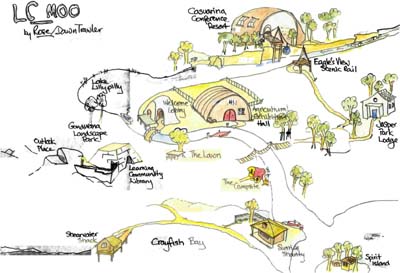
I had a couple of shots trying to log on to LC_MOO but actually kept 'falling off' or getting dropped off or what I don't know. Anyway my overwhelming impression from using LC_MOO in the earlier part of the course was of a somewhat confusing, old school online world that is no doubt immersive when you get to know it, but which is kind of arcane when first come across.

From what I've observed LC_MOO has no trouble dealing with a large number of people being online - all at one time. So mass synchronous conversations are technically possible. But once again I start to think that such conversations are improbable when the user numbers goes north of about 6-8 to polite, well versed users or so. Beyond this number a discussion degenerates into a babble for me.


POD Project 5: Interact chat

Once again I missed an organised activity on August the 19th. I simply couldn't get the time off work. I ended up reading through the log of the chat and had a posthumous lurk as it were. For me the standout comments of the log were the ideas about people reading 'tone' into plain text comments and the need for people to be regular users of the online tool to better understand how it works and so on. Also the challenge of more than a couple of handfuls of people talking at once was also raised - this seems to be a challenge for any form of real time online communication tool and reinforces my prejudice against using these tools in classrooms with 30 students. The other important idea, for me, was the idea presented by Jessica Delahunty, who put forward the contention that
the ultimate goal of online interaction is different between school students and work colleagues. While both aim to promote collaboration, the record-keeping in a business setting becomes very important.
This idea really fed into my ideas about corporate memory and about knowledge management for corporates. Ultimately this idea fed into my contribution towards completing question 2 of the assignment CIO recommendations that our POD group put together.

POD Project 4:Gmail Chat

Gmail chat was great - I use it all the time with a range of friends - although we prefer to use Gchat more often (that way we can do other things at the same time and not appear to be rude perhaps). Quite frankly I'm sure we like chatting together because we don't have to appear to be paying attention (even though we are).

Sadly I completely missed Ken's chat (Finance Committee Meeting after school). Gchat works as well for me as Skype does. I like neither as much as plain text chat and the ability to link to pictures and so on. However I don't believe that Gchat (or Skype) really excels when more than two people are having a conversation. More voices = more frustration and dropped / ignored threads.


POD Project 3: Facebook

Back on August the 18th I finally joined Facebook and joined up with the ITC510 Group. I even made a contribution. Anyway I lurked around a bit but kind of felt that my contribution to the discussion was somewhat at cross-purposes with other people. Almost as if I was talking in a crowded room with a multitude of other people all talking at once. To me this is one of the great contractions of Web 2.0. The actual discussion at the time might not seem like much, but afterwards, when you read back over it - well it's surprisingly informative to look back on.

POD Project 1: Definitions and Keywords

i) Social networks are social structures composed of individuals (or organizations) called "nodes" that are tied or “connected” by interdependencies such as friendship kinship, financial exchange, dislike, sexual relationships or relationships of beliefs, knowledge or prestige.


ii) Professional development refers to skills and knowledge attained for both personal development and career advancement. Professional development encompasses all types of facilitated learning opportunities, ranging from college degrees to formal coursework, conferences and informal learning opportunities situated in practice. It has been described as intensive and collaborative, ideally incorporating an evaluative stage. There are a variety of approaches to professional development, including consultation, coaching, communities of practice, lesson study, mentoring, reflective supervision and technical assistance.


iii) Web 2.0, The term "Web 2.0" is commonly associated with web development and web design which facilitate interactive information sharing, interoperability, user-centered design[1] and collaboration on the World Wide Web. Examples of Web 2.0 include web-based communities, hosted services, web applications, social-networking sites, video-sharing sites, wikis, blogs, mashups and folksonomies. A Web 2.0 site allows its users to interact with other users or to change website content, in contrast to non-interactive websites where users are limited to the passive viewing of information that is provided to them.


iv) Blogs are a type of website, usually maintained by an individual with regular entries of commentary, descriptions of events, or other material such as graphics or video. Entries are commonly displayed in reverse-chronological order. "Blog" can also be used as a verb, meaning to maintain or add content to a blog. Many Rapid online website tool that is frequently used to provide commentary or news on a particular subject; others function as more personal online diaries. A typical blog combines text, images, and links to other blogs, Web pages, and other media related to its topic. The ability for readers to leave comments in an interactive format is an important part of many blogs. Most blogs are primarily textual, although some focus on art (Art blog), photographs (photoblog), videos (Video blogging), music (MP3 blog), and audio (podcasting). micro-blog:


v) Microblogging is another type of blogging, featuring very short posts. An extremely detailed form of blogging that seeks to capture a moment in time. Sites, such as Twitter, allow bloggers to share thoughts and feelings instantaneously with friends and family and is much faster than e-mailing or writing.


vi) Wiki’s are websites that use wiki software, allowing the easy (no coding knowledge needed) creation and editing of any number of interlinked Web pages, using a simplified markup language or a WYSIWYG text editor, within the browser. Wikis are often used to create collaborative websites, to power community websites, for personal note taking, in corporate intranets, and in knowledge management systems. Most wikis serve a specific purpose, and off topic material is promptly removed by the user community. Such is the case of the collaborative encyclopedia Wikipedia. In contrast, open purpose wikis accept all sorts of content without rigid rules as to how the content should be organized.vii) Mashups are web pages or applications that combine data or functionality from two or more external sources to create a new service. The term mashup implies easy, fast integration, frequently using open APIs and data sources to produce results that were not the original reason for producing the raw source data. An example of a mashup is the use of cartographic data to add location information to real estate data, thereby creating a new and distinct web API that was not originally provided by either source.


Bibliography: i-vii All Wikipedia

POD Project 2: EtherPad

I know from reading around the ITC510 Blogosphere that making best use of EtherPad proved difficult for other people doing this course. This part of the course was difficult for me also - mostly because I was offline for a week or so and badly overwhelmed with work duties at that point in time. In itself this raises a point about online communities: the need to be constantly online. Both my wife (an avid Facebooker) and I were offline for a couple of weeks. I spent a surprising amount of that time fielding questions about my wife not being on Facebook (Is everything all right? Is she OK? What's happened to XXXX?) Well, she lives. She just didn't have time to be online. So I apologise to my fellow Blue Podder's.

For the sake of the exercise I belatedly set up a public etherpad and unblocked it (a tale itself) from my school's blocked list ("Why don't you use Moodle? Moodle is what we use!") and had a go with the kids. Neat. Sort of. It shows me how this sort of tool could be used to collaborate on a document as a group in real time. But as an educator working with kids it was more of fun diversion than a great accomplishment.

October 23, 2009

Assignment 2, part B: How do Web 2.0 tools (blogs, wikis, podcasts and video lectures) complement such social networks? - FOR MERGING / EDITING

As observed by Paul Scott: Web 2.0 is about users and content, rather than just surfing on the Internet. Web 2.0 is about what the Internet can do for an active collaborator, rather than a passive viewer. To this end Web 2.0 tools such as blogs, wikis, podcasts and video lectures can complement enterprise-centric social networks (networks focused on creating value by taping into the knowledge of active collaborators) by allowing employees to present / share relevant information in ways that fellow employees will find accessible and easy to access, interpret and understand.


Consider the flexibility of Web 2.0 tools with regard to the issue of supporting effective knowledge management (KM) within an organisation: KM, according to Wikipedia, is about the practices used by an organisation to identify, create, represent, distribute and enable the adoption of insights and experiences (the 'common knowledge' held by experienced employees). I would propose that blogs, wiki's, podcasts and video lectures could be used by an organisation to support a fuller range of knowledge capture about the organisation to be then stored and transmitted between employees within that organisation in ways that transcend the constraints of the formal memo or a formal written document. An example of such a constraint is the traditional way that documents are created for print (and then distributed and filed) and shared on a perceived needs basis that doesn't necessarily allow for future knowledge discovery.


However, the use of Web 2.0 tools could support an organisation to move away from the creation of static documents and allow the organisation to more achieve such organisational objectives as

improved performance, competitive advantage, innovation, the sharing of lessons learned, and continuous improvement of the organisation. KM efforts overlap with organisational learning, and may be distinguished from that by a greater focus on the management of knowledge as a strategic asset and a focus on encouraging the sharing of knowledge. KM efforts can help individuals and groups to share valuable organisational insights, to reduce redundant work, to avoid reinventing the wheel per se, to reduce training time for new employees, to retain intellectual capital as employees turnover in an organisation, and to adapt to changing environments and markets (McAdam & McCreedy 2000)(Thompson & Walsham 2004)

Perhaps the key flexibility of Web 2.0 tools is that they encourage the getting 'out there' of knowledge and content and they make such knowledge easy to comment upon, build upon and respond to. At the most obvious level this could take the form of an organisation archiving or publishing online its documents onto a tool like Scribd which is a social publishing site designed to convert and share documents online. Obviously an organisation would be looking to use an 'in-house' solution or license Scribd's functionality for its own internal (company / private behind a firewall) use. Similar solutions exist for the online collection and sharing of PowerPoints and Spreadsheets (Google documents, Slide Share, EditGrid, etc.). A key advantage of these solutions is their ability to allow for responses and commentary. And this sociability, literally the encouragement to add one’s voice to the discussion - to see the organisation’s knowledge documents not as an endpoint but as a starting point for further conversation and response and growth of ideas and understanding.


However transcending this, the use of such Web 2.0 tools as blogs, wikis, podcasts, video lectures and other digital media can also allow for a wider range of informal, anecdotal, ad hoc or published media releases / advertising to be captured, stored and shared in way that makes it accessible to vie, link to, embed, MASH-up and generally be taken advantage of by employees in future situations. Corporate memory is more than just words or memos and Web 2.0 tools raise a possibility for capturing and taking advantage of a range of content that exists (and has meaning) within an organisation. As tools such as Facebook, Twitter and Second Life demonstrate, Web 2.0 tools can be inherently social but they can also be private and users (organisations) can set and control who gets access to information and who doesn’t - with full ability to revert to previous versions of information. A good example of this is to be found in the ability of a wiki to allow for data to be added or deleted without destroying earlier copies / revisions of related data. This allows for data integrity in a Web 2.0 world whilst giving employees an 'in' to data with the intention of employees gaining benefit for themselves (and ultimately the organisation) from the accessing of that data.


So in these ways, Web 2.0 tools can provide a substantial complement to a company's social network because they provide easily extensible (and generally comprehensible to employees) ways of linking to, extending, responding and explaining key data (or even supplanting that data with more contemporary information) in a way that non-destructively adds to existing data / knowledge. This can potentially also happen in extremely rapid ways - through, for example, mobile devices that are capable of connecting to Web 2.0 services from remote locations - and receive updates equally remotely (as evidenced by access to Facebook or Twitter via mobile phones).


Ultimately I don’t believe that there is single Web 2.0 technology that will be all things to any given organisation. Perhaps metaphorically, Web 2.0 tools will be best used in collaboration with each other - a mashup or amalgam of blogs, wikis, tweets, podcasts, video and so on.


(McAdam, Rodney; McCreedy, Sandra (2000). "A Critique Of Knowledge Management: Using A Social Constructionist Model". New Technology, Work and Employment 15 (2)

Thompson, Mark P.A. & Geoff Walsham (2004), "Placing Knowledge Management in Context", Journal of Management Studies 41 (5): 725-747

October 19, 2009