Search This Blog

October 25, 2009

POD Project 10: Webex

Just got off using Webex with my father-in-law in Thailand. Fantastic tool. We started off trying to use Skype and IM and email to send a file (a template for something that I want made in Thailand) and eventually gave up as it all seemed too hard. I convinced him to try out Webex's offer of a free trial with me and we were able to get the job done. It was a real eureka moment for me being able to text to chat (he's having trouble with his webcam) whilst also being able to share the documents that I needed him to see and review with me before he went off to the shops to get my new ... wait for it ... camera strap made up (don't ask). Being able to highlight a document was a real highlight (no pun intended) because it left me feeling *fairly sure* that we were both on the same page as it were when we were talking about what I wanted done.

At any rate I could see from using Webex how it would have real potential in the classroom - or in a more broadly distributed classroom / learning activity.

The only downside that I could see are the costs. US$59.00 a month, cancel any time isn't prohibitive but it's way out of reach of a teacher's classroom budget and it would be hard, if not impossible, to get the money from some other school budget line (Moodle is already provided to schools). Asking for Webex could see you being labelled as 'reinventing (or rebuying) the wheel'. However the tool works really well and it's an option. It would be great to see a full free academic version for schools. Much like wikispaces provides full free wiki's for educators that ask. Click here to see a video of how Webex works.



October 24, 2009

POD Project 9: Twitter - not for twits?


AH Twitter. Heard the bird and am following you Ken (well tried to anyway - Twitter reported a failure when I set up).

At any rate one of the strengths of Twitter is it's forcing nature of only giving you 140 characters to get whatever's on your mind ... out. I think that the key strength of this is that it might encourage good linking and leading to new information. This slideshow talks about the opportunities for education. In a nutshell Twitter could be used to share, update, or keep others informed of how you are going with a task. Beyond this it requires users to be relevant, make their tweets count, ask questions to get answers back from people, and be yourself. Perhaps Twitter is an example of a Web 2.0 tool that would actually work better with many more than the typical 6-8 people online that I seem to think works best for everything else chat wise that I've tried.

A series of links for how educators can use Twitter.

POD Project 8: TokBox

This was a little bit odd. I actually managed to sneak some time at school and get online with a laptop that had voice but no video capacity. I logged on to the address that Ken provided and though - good there's someone on already. I could see a man with a beard sitting in what appeared to be an office more or less looking like he was waiting for things to happen. Anyway he must have twigged that he was online and that I was looking at him. He ended up saying something like "Oh, I've been online this whole time. How embarrassing ..." And then he disconnected. I'm still not sure what that was about.
I ended up logging off and taking care of some student behaviour management. One of the nice things about TokBox is that you don't have to download anything or install anything - and it was quick to set up on - even if you aren't using your regular computer. All this just reinforces the idea that there is an enormous range of Web 2.0 communication options out there. A suitable Web 2.0 mix can potentially be put together for almost organisation / set of needs and concerns. I think.

POD Project 7: Skype Conference Call August 26th

I kicked off with a small group chat with my Blue Group team mates Sarah E and James V. When we were chatting together as a small group the technology worked well - clear and undistorted sound. However after we all logged off and restarted with Ken I had a lot of problems with feedback and dropouts and the like.
I've often used Skype 1-to-1 and found it to work quite well in that context (depending on the speed of both parties Internet). I could see a lot of potential for Skype (or Moodle, or Centra) to be used for online chats / presentations by experts to whole classes / schools of students. Again I think that this Web 2.0 technology works best when less people use it in the same space at a given time. Too many users simply makes it confusing to listen to and also, in this case, appears to overwhelm the capacity of the collective conversation network.


POD Project 6: Blue POD NING


Sarah Eade set up the Blue Group Ning. Of all the Web 2.0 tools that we used I found it to be the best wrapper for a collaborative online activity. As a teacher I liked the fact that it featured good control over privacy and security and like the Wiki's that I favour, Nings require that the administrator has invited users to join. However once a user is a part of the Ning the are then free to add content and actions and start to get things moving as it were.
Nings, incorporating as they do, email with individual user inboxes, forums, an automatic online chat tool with any other member(s) that is / are online, as well as the capacity to upload photos and video content to; make an excellent candidate for the sort of active, sustainable sort of online community that our group talked about and ultimately made recommendations about in Assignment 2. For these reasons I see a lot of potential for using Ning's in the classroom or even across a whole school. Further evidence of this can be seen here and here (where it's called a "roll your own myspace network").

However there are challenges for using free services like Ning. A lack of control over advertising on free sites is one example talked about here:

Ultimately using 'free' tools must be considered within the constraints of audience and their sensitivity to advertising aswell as the real costs involved in setting up free things. The question might well need to be considered (and answered): Is it ultimately going to be 'cheaper' and more controlled to spend some money and time and on using a 'free' alternative such as Drupal or the like that will allow the user to set up (and potentially grow) a site on a domain of their own.


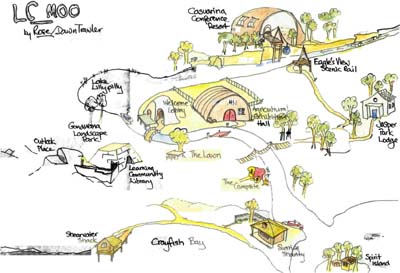
POD Project 5: LC_MOO we hardly knew you

I had a couple of shots trying to log on to LC_MOO but actually kept 'falling off' or getting dropped off or what I don't know. Anyway my overwhelming impression from using LC_MOO in the earlier part of the course was of a somewhat confusing, old school online world that is no doubt immersive when you get to know it, but which is kind of arcane when first come across.

From what I've observed LC_MOO has no trouble dealing with a large number of people being online - all at one time. So mass synchronous conversations are technically possible. But once again I start to think that such conversations are improbable when the user numbers goes north of about 6-8 to polite, well versed users or so. Beyond this number a discussion degenerates into a babble for me.


POD Project 5: Interact chat

Once again I missed an organised activity on August the 19th. I simply couldn't get the time off work. I ended up reading through the log of the chat and had a posthumous lurk as it were. For me the standout comments of the log were the ideas about people reading 'tone' into plain text comments and the need for people to be regular users of the online tool to better understand how it works and so on. Also the challenge of more than a couple of handfuls of people talking at once was also raised - this seems to be a challenge for any form of real time online communication tool and reinforces my prejudice against using these tools in classrooms with 30 students. The other important idea, for me, was the idea presented by Jessica Delahunty, who put forward the contention that
the ultimate goal of online interaction is different between school students and work colleagues. While both aim to promote collaboration, the record-keeping in a business setting becomes very important.
This idea really fed into my ideas about corporate memory and about knowledge management for corporates. Ultimately this idea fed into my contribution towards completing question 2 of the assignment CIO recommendations that our POD group put together.